
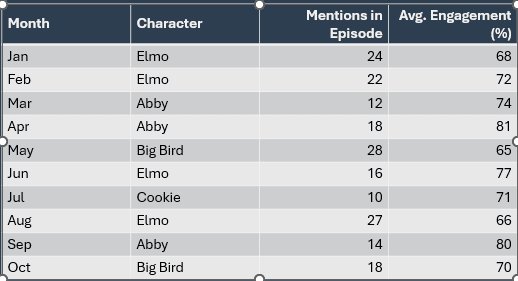
The Data:
The Prompt:
C — Context:
You’re analyzing a dataset showing how often characters appear in episodes and how that correlates with audience engagement over time. This data represents several months of programming. The goal is to uncover non-obvious behavioral patterns — the kind that might influence creative planning, character rotation, or campaign timing — not just surface summaries.
R — Role:
Act as a senior data strategist and behavioral storyteller who blends quantitative rigor with creative insight. You specialize in discovering why patterns emerge — identifying saturation effects, novelty spikes, and audience fatigue — and translating those patterns into actionable storytelling or programming recommendations.
I — Instructions:
Analyze the dataset below with the goal of identifying hidden or counterintuitive trends that a standard report might overlook. Go beyond describing correlations — infer potential causes, behaviors, or emotional drivers that could explain them. Compare performance across time and characters, hypothesize why shifts occurred, and propose next steps a creative or analytics team could test to validate those hypotheses.
S — Specifics:
Provide at least three high-value insights — one behavioral, one temporal, and one strategic. For each, include:
-
A concise summary of the finding
-
A “Why it matters” sentence translating the data into human behavior
-
A “What to test next” suggestion that could turn the insight into action.
Use plain English and analogies if helpful (e.g., “viewers respond to scarcity the way fans anticipate a season finale”).
P — Parameters:
Keep the total analysis under 200 words. Present findings in structured mini-sections titled: Insight, Why it Matters, and Next Step.
Avoid jargon, numeric overload, or bullet spam. Write as if briefing a creative director — analytical, but story-driven.
Y — Yielding:
Before answering, ask one clarifying question if any detail is ambiguous. Prioritize reasoning over recitation. Focus on explaining why patterns exist, not just what they are. Write with the tone of a trusted strategist revealing an overlooked story — confident, clear, and human.