A four-step method for training that changes how people actually work, not just what tool they open.
By Jeremy Swiller, ANA-Credentialed AI Training Instructor. Founder, Flux+Form. Published September 16, 2026.
To train your creative team on AI, train the whole team together, practice on live client work, and keep the ideas human. Use AI for research, concept testing, synthetic production of ideas your team already wrote, and adaptations. Spread the training over several weeks and give it at least five hours.
In a study published in 2024, two researchers gave short-story writers a few ideas from ChatGPT before they started. Judges rated the AI-assisted stories more novel and more useful. Then Anil Doshi and Oliver Hauser compared the stories to each other, and the ones built on AI ideas had drifted closer together. Each writer improved. The pile got more alike.
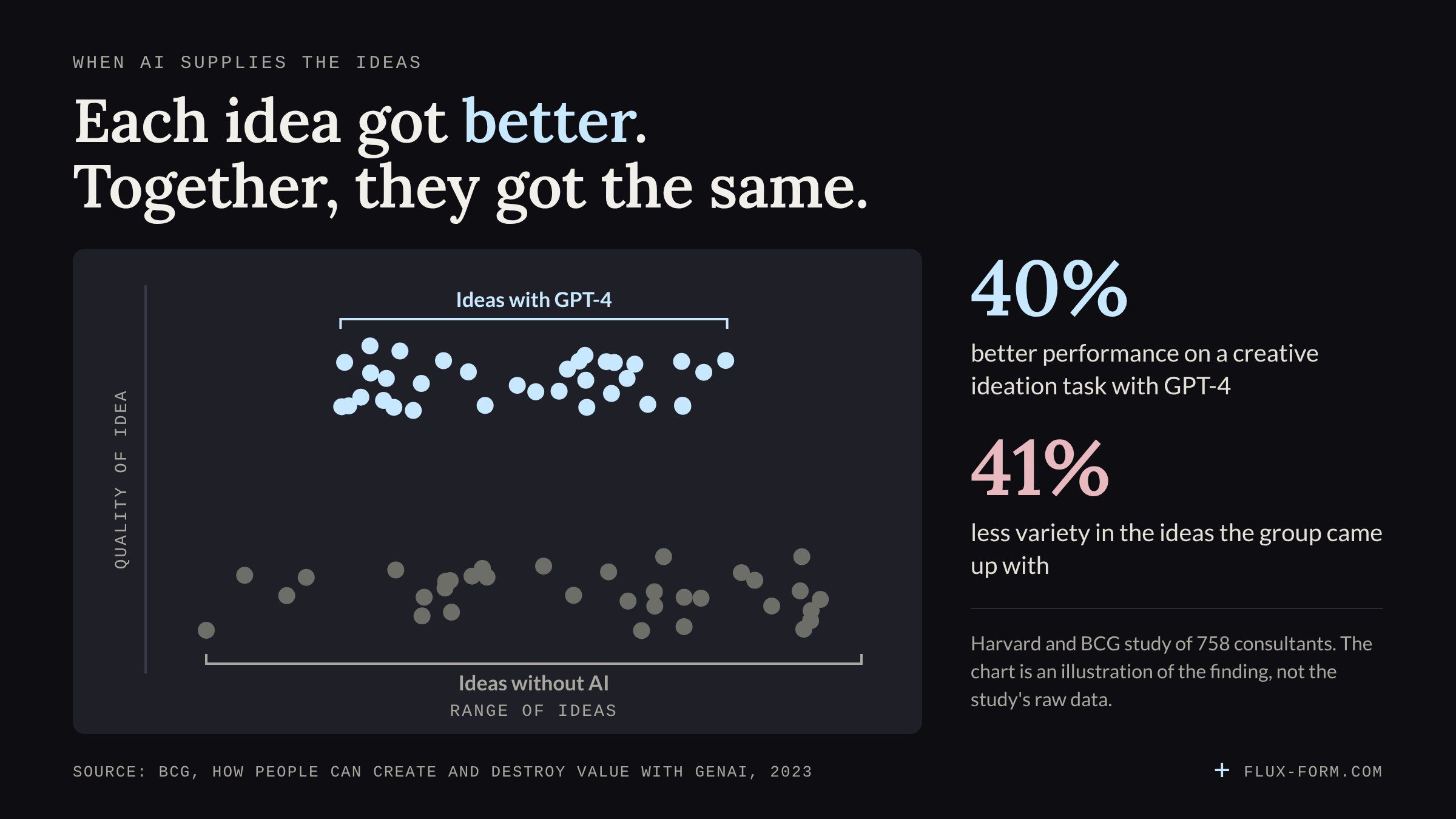
Harvard and BCG saw the same pattern with consultants. People who used GPT-4 to come up with ideas scored 40% higher than people who didn’t, and the variety across their ideas was 41% lower.
Both studies measured one thing: AI supplying the idea. That is the one job this method never gives it.

Most AI training gets delivered, completed, and forgotten inside a month. Docebo’s 2026 enterprise learning survey found that 85% of workers cannot connect what they learned in AI training to their actual job, and Fast Company’s coverage of that research points to the same root cause every time: training happens in a system disconnected from the tools people use all day, on generic scenarios instead of their own files, briefs, and deadlines.
Fifty-six percent of workers say they never had protected time to complete training in the first place, so it got layered on top of an already full week. That isn’t a training-quality problem. It’s a design problem, and it shows up at the highest level too.
Training that never leaves the sandbox teaches people to be good at the training, not good at the job.
McKinsey’s 2025 Global AI Survey found 88% of organizations now use AI somewhere in the business, but 62% are still stuck in experimentation or piloting. Training that never leaves the sandbox is a large part of why so few organizations ever cross that line.
Agencies feel this sharply because adoption has outrun training. Forrester’s June 2026 survey found that 90% of US marketing agencies use generative AI, while BCG’s 2026 AI at Work study of about 12,000 employees found that only 36% feel adequately upskilled. Clients have noticed. In the World Federation of Advertisers’ September 2026 study, 69% of major brand owners require their agencies to disclose AI use.
A finance team learning a new AI tool is learning a new way to do the same job. A creative team learning AI is being asked to change the thing that made them hireable in the first place: taste, style, a point of view built over years. Envato’s “Beyond Adoption” report, surveying 1,780 creative professionals, found graphic designers and illustrators report frustration with AI at nearly double the rate of marketers and content creators, because their craft sits in the highest-barrier category: work built on a signature style AI can imitate but not originate.
Training a creative team on AI has to close a trust gap, not just a skills gap.
Creative is a human activity. The judgment about what’s worth making, the strange connection nobody else saw, the line that makes a client sit up. That’s the work clients pay for, and it’s the part both studies above say AI flattens.
Everything around it is fair game. In our workshops, AI does four jobs:
The idea itself stays with people. That’s the line that keeps an agency’s work from drifting toward everyone else’s.
The Craft Transfer Method is a four-step approach built around one principle from learning science: a new skill only transfers to real work when the practice environment mirrors the work environment. Training that happens in a separate tool, on someone else’s sample files, teaches people to be good at the training, not good at the job.
The four steps, in order: map the craft, train inside the work, train the team together, and bring leadership in. Each step exists to fix a specific, documented reason training fails, in the order those failures actually compound.
Before any session gets scheduled, build a simple heat map of the team, discipline by discipline: where does AI genuinely reduce risk and save time, and where does it threaten the specific craft a role is built on? A production designer swapping templates and a brand illustrator defending a signature style are not on the same map, and the training has to speak to both.
This is a baseline measurement problem: you cannot coach what you have not measured. A short discipline-by-discipline audit, done before the first session, tells you who needs to learn a tool and who needs to be shown, concretely, that their craft isn’t the thing being automated.
Place each person on a simple three-point scale, resistant, assisted, or transformed, within their own discipline. That scale is the baseline every later measurement runs against.
Training inside the work means the practice material is a real brief, a real client file, a real deadline, not a demo dataset built for the workshop. It also means protecting the time to do it. Docebo’s research found 78% of workers train on a system disconnected from the tools they actually use, and 56% never had dedicated time carved out to practice, meaning the training got stacked on top of a full workload rather than substituted for part of it.
The fix is structural, not motivational: block real production hours for practice, on real projects, before asking anyone to change how they work day to day.
Real client work also teaches the skill that matters most with AI: supplying context. MIT’s Project NANDA studied more than 300 enterprise AI initiatives in 2025 and found that most AI tools do not retain feedback or adapt to context on their own. The brief, the brand guidelines, the work a client already approved: learning to feed that material in is what turns generic output into usable work. When practice runs on live accounts, the hours spent learning are hours already spent on the business. Agree which tools are approved for client material before the first session, so practice never puts a client’s confidential work at risk.
Agencies do not ship work discipline by discipline. A campaign moves from strategist to copywriter to art director to producer, and AI changes every one of those handoffs. Training each discipline on its own teaches people to use AI inside their own lane and leaves the handoffs, where most of the friction lives, untouched.
The strongest evidence on AI and teamwork comes from a field experiment with 776 professionals at Procter & Gamble, published in Organization Science. Teams using AI were about three times as likely as the control group to produce a solution in the top 10%. The same study found AI broke down functional silos: without it, R&D specialists leaned toward technical solutions and commercial staff toward commercial ones, while people using AI produced more balanced ideas regardless of their background.
Different starting points are real, and the shared program absorbs them. Everyone takes the same session, then applies it to their own client work in the assignment that follows, so a copywriter already fluent in AI and an art director opening it for the first time each leave with something useful at their own level. The agency ends with one vocabulary, one quality bar, and one answer when a client asks how AI touches their business. We train strategy, creative, account and production together because a rising tide lifts all ships.
Because when leadership skips it, staff stop asking permission. PagerDuty’s 2026 Shadow AI Workplace Survey found 66% of office professionals have used an AI tool they believed was not permitted under company policy, and nearly half said they would rather use it quietly than risk being told no. Separately, Verizon’s 2026 Data Breach Investigations Report found 45% of employees regularly use AI tools on corporate devices without approval. Creative teams handling unreleased client work are exactly the group that shadow AI use puts most at risk.
Leaders who understand the tools set clearer rules, and teams with clear rules have less reason to hide what they are already doing.
Leadership presence also drives use. Gallup found in 2025 that employees whose managers actively support AI are 2.1 times as likely to use it several times a week, yet only 28% strongly agree they get that support.
The order in which we teach AI rests on two ideas. The first comes from instructional design research: people learn complex skills best through real tasks, arranged from simpler to more demanding, with each stage building on the last. A 2022 meta-analysis of programs built on that model, known as four-component instructional design, found a large effect on performance (d = 0.79). The second is practical. The sequence follows the path work already takes through an agency: brief, concept, test, make, deliver, run.
Foundations of large language models and generative AI come first because AI fails unevenly. In the Harvard and BCG “jagged frontier” study of 758 consultants, people using AI on tasks it handled well finished 12.2% more tasks, 25.1% faster, at more than 40% higher quality. On a task just outside its abilities, they were 19 percentage points less likely to reach the right answer. A team that cannot tell which side of that line it is on will trust the tool at the wrong moment.
Learning AI for strategy and briefing comes before any making because AI pulls work toward the middle. In a 2024 Science Advances study of 300 writers, AI-generated ideas made individual stories more creative, but also made them 10.7% more similar to one another. For an agency, sameness across clients is the real risk. A sharper brief is the defense: when the team uses AI for insight and positioning first, every prompt that follows carries a point of view the client paid for.
Using AI for testing and feedback means ideas get pressure-tested while they are still cheap to change. Harvard Business School researchers found that AI models could reproduce realistic consumer preferences and price sensitivity, while cautioning that synthetic answers still need validation against real people. Teams learn to use it to surface objections early, and to recognize when a question needs a human answer.
Production is where AI is most visible and where most teams want to begin. Placed after strategy and testing, it arrives once the team has something specific to say, so image prompts carry the client’s voice. Video follows stills because it layers motion, timing, and sound on top of the same visual decisions, a direct application of the simple-to-complex principle.
An automation follows fixed steps. An agent decides which step comes next. Teams that have built a few automations understand their own workflow well enough to hand some judgment to an agent and to know where a human checkpoint belongs. BCG’s 2025 survey found that only a third of employees understand how agents work, which is why agents are taught once the team can properly supervise them.
Seven stages of training still leave seven separate skills. The last stage turns them into one way of working: which steps use AI, where people review the work, what gets documented, and how each new account starts from what the last one taught the team.
This is the stage that pays the training back. In McKinsey’s 2025 State of AI survey of 1,491 participants, redesigning workflows had the biggest effect on bottom-line impact of the 25 factors it tested, yet only 21% of organizations using AI had fundamentally redesigned any workflows. The instructional design research points the same way: skills practiced in pieces carry over to real work once they are practiced together.
For an agency, an operating model makes the investment durable. New hires inherit a documented system. Every client gets the same standard. When a client asks how AI is used on their business, the team has one clear answer. In the Creative Cadence Workshop, this stage is the Creative Cadence Framework, the system the agency keeps after the training ends.
Plan on about eight weeks. BCG’s 2025 survey of more than 10,600 employees found that regular AI use rises sharply once people receive at least five hours of training, and only a third said they had been properly trained.
How the hours are spread matters too. A review of 839 learning assessments across 317 experiments, published in Psychological Bulletin, found that practice spaced over time is retained better than the same practice crammed together. One ninety-minute live session per week, followed by a twenty-minute assignment on that week’s client work, adds up to about twelve hours of instruction and gives each lesson a week to take hold. The baseline re-measurement described in the next section then shows whether it did.
Not by a completion certificate. A completion rate tells you who sat through the material, not whether anything changed about how they work. The Craft Transfer Method measures against the same discipline-specific baseline built in step one: can this designer now use AI for research, testing and adaptations without losing the signature style clients hired the agency for? Can this copywriter tell, unprompted, when an AI draft needs a full rewrite versus a light edit?
Re-run that same baseline check 60 to 90 days after training. If the gap between “assisted” and “transformed” hasn’t moved for a given discipline, that tells you exactly where that discipline needs more support.
The costs compound rather than stay flat. Superside’s 2025 State of Creative Teams report found 76% of creative professionals already report burnout, 40% say their teams are understaffed for the work in front of them, and 96% still expect AI to make things move faster regardless. Layering disconnected, generic training on top of a team already in that state doesn’t build capacity. It adds one more disconnected task to a week that has no room for it.
Research covered by eMarketer and Harvard Business Review found marketers report the highest rate of AI-induced cognitive overload of any function measured, with affected workers 39% more likely to make major errors or consider quitting. A creative team that never gets past the sandbox stage of AI training is a team absorbing all of the pressure to adopt AI and none of the relief it is supposed to deliver.
| Generic AI training | The Craft Transfer Method | |
|---|---|---|
| Curriculum | A single one-off session | One shared program for the whole team, applied to each person’s own client work |
| Practice material | Generic sandbox exercises | Real briefs, real files, real deadlines |
| Time | Added on top of the existing workload | Protected production hours, planned in advance |
| Leadership | Trained separately, or not at all | Trained alongside staff, on the same material |
| Success measure | Completion certificate | Discipline-specific baseline, re-measured at 60-90 days |
Start with the map, not the curriculum. Spend a week building the discipline-by-discipline heat map from step one before scheduling a single session, so the training that follows is built for the team you actually have.
Protect real time before you announce a real program. Block production hours for practice before anyone hears the word “training,” so the first thing the team learns isn’t that this is one more thing stacked on top of their week.
Put the people who approve the budget through the same material as the people who will use the tool. If leadership can’t sit through the training, that’s the clearest signal available that the program isn’t ready to launch.
The Creative Cadence Workshop runs a full creative team through this method live, if you want to build it together rather than alone. It won’t map your team’s craft for you. Only your own discipline-by-discipline audit can do that.
Thirty minutes, no pitch, just a real conversation about whether the workshop is the right fit.