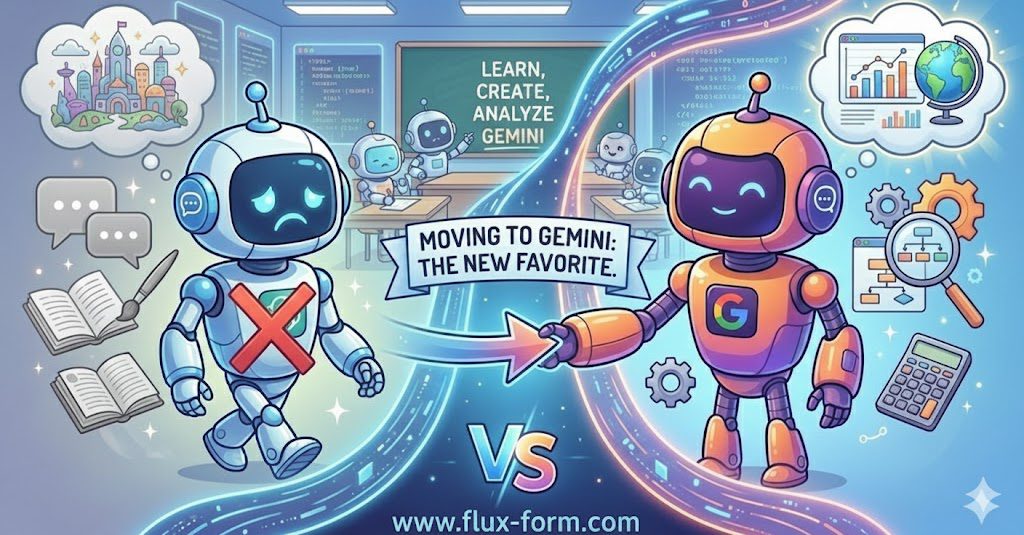
I’ve been a ChatGPT loyalist for years. I’ve sung its praises. I’ve trained agencies on it. I’ve built entire workshops around it. This isn’t me chasing the shiny new thing. This is me following the results. After months of running both tools side by side for real client work, content creation, and code generation, I’m officially making the switch. Here’s why.
The Accuracy Problem Nobody Wants to Admit
We all should know about hallucinations by now, and I try to take uncited data from ChatGPT with a grain of salt. But my experience with ChatGPT hallucinating has become untenable. It confidently makes shit up. All the time. And I don’t just mean hallucinating obscure facts. I mean basic, verifiable information that a five-second Google search would debunk.
Gemini 3 doesn’t have that problem nearly as often. Why? Because it’s plugged directly into Google’s search infrastructure. When I ask about current events, market data, or anything that requires up-to-date information, Gemini actually checks its work against live web results.
ChatGPT’s knowledge cutoff means it’s constantly playing catch-up. And when it tries to fill in the gaps, it guesses. Badly, sometimes. I’ve watched it confidently cite studies that don’t exist, attribute quotes to people who never said them, and invent statistics out of thin air.
I don’t say this lightly…it’s become a liability.
Prompt Adherence: Actually Doing What I Asked
In the battle between ChatGPT vs Gemini, ChatGPT has gotten worse at following instructions.
Maybe it’s the safety guardrails. Maybe it’s the RLHF tuning. But somewhere along the way, getting ChatGPT to actually do what you want became a negotiation. I’d give it clear parameters, word counts, formatting requirements, and it would just… do its own thing. Every response felt like it was auditioning for a TED talk I didn’t ask for.
Gemini 3 acts differently. When I say “give me exactly five bullet points,” I get five bullet points. Not seven with a helpful preamble about why bullet points are great. For anyone building workflows, creating content at scale, or trying to maintain consistency across outputs, this matters more than any benchmark score.
The Integration Advantage
This is where the competition isn’t even close. Gemini is embedded into everything I already use: Gmail, Docs, Sheets, Drive, Meet, Calendar. It can read my email threads, pull from my Drive files, summarize my meetings, and cross-reference all of it in a single research report. ChatGPT? It has plugins. Some of them work. Sometimes. I’m too busy to babysit these, even if I wanted to…which I don’t.
Google’s Deep Research feature can now connect directly to my Workspace content. I can ask it to analyze my brainstorming docs alongside competitor web research and get a comprehensive report without uploading a single file. The integration isn’t an add-on. It’s native.
For agencies already running on Google Workspace (which is many of you), this is a massive unlock. Stop copy-pasting between apps. Stop downloading, uploading, converting. Just work.
Nano Banana: Image Generation That Actually Gets It
ChatGPT’s DALL-E integration is fine. It makes pictures. Some of them are even usable. But Google’s Nano Banana is the first tool that unlocked the promise of what Generative AI was supposed to deliver. Character consistency across images? Done. Blending multiple photos together seamlessly? Done. Editing existing photos with natural language while keeping the person looking like themselves? Actually done. The “3D figurine” trend that flooded social media? That was Nano Banana. It attracted over 13 million new users to Gemini in four days. Because it’s not just a novelty. It’s genuinely useful for rapid visual content creation. And now with Nano Banana Pro, we’re talking about infographics, data visualization, text rendering in multiple languages, and integration across Slides, Docs, and NotebookLM. I can take my research notes and turn them into a polished presentation visual without leaving the Google ecosystem.
Veo 3.1: Video Generation That’s Actually Useful
When we think about ChatGPT vs Gemini, here’s where Gemini pulls ahead in ways that matter for production work. Veo 3.1 generates 8-second videos in 1080p with native audio. Not silent clips. Full videos with synchronized sound effects, ambient noise, and even dialogue with accurate lip-sync. I’m starting to integrate the “Ingredients to Video” feature lets me combine multiple reference images (a character, a location, an object) and Veo creates a coherent scene from them. Character consistency across multiple prompts. Control over camera positioning. The ability to extend scenes up to 60 seconds through sequential generation.
Let’s be clear, it’s not perfect. But for quick concept videos, social content, and pitch visualizations, it’s eliminating hours of work. And let’s not forget, this is as bad as it’s ever going to be. This is Google’s advancement of a couple of years. I can’t even imagine what a decade will look like.
OpenAI’s Sora exists, but it’s still separate from ChatGPT, still limited in access, and still not integrated into a broader creative workflow. Veo lives inside Gemini, inside Flow (Google’s AI filmmaking tool), and inside the entire Google ecosystem.
Vibe Coding: Where Gemini Leaves ChatGPT Behind
Both tools can write code. That’s table stakes now. The difference is what happens after. ChatGPT writes code and hands it to you. Here’s your Python script. Here’s your React component. Good luck figuring out how to run it, connect the pieces, and deploy it somewhere useful. You’re still the developer. ChatGPT is just a faster typist. Gemini’s AI Studio Build mode does something different. I describe what I want, and it doesn’t just write code. It assembles a working application with a live preview, wires up the APIs automatically, and gives me a visual interface to iterate on. The “Annotation Mode” lets me point at any element in the preview and say “make this button blue” and it updates. No code editing. No debugging. Just conversation.
When I’m done? One-click deploy to Google Cloud Run. From idea to live app without touching a terminal. ChatGPT’s code generation is powerful. But I still need to be a developer to use it effectively. Gemini’s approach lets me stay at the “what do I want this to do” level while it handles the “how do I make this work” layer. For rapid client demos, internal tools, or testing ideas before investing in real development? Gemini closed a gap that ChatGPT doesn’t even know exists.
ChatGPT vs Gemini: The Bottom Line
I’m not saying ChatGPT is dead. It’s still powerful. It’s still useful for certain tasks. The creative writing is arguably still better. But for client work? For accuracy? For integration? For visual and video content? For building things quickly? Gemini has caught up and, in several ways, pulled ahead. Sam Altman announced a code red yesterday.
I’m following the results. And right now, the results are pointing to Gemini.
The future of AI isn’t about loyalty to a brand. It’s about using the tool that makes your work better. Right now, for me, that’s Gemini.
Time to update your workflows accordingly.
Want help implementing AI tools in your agency? Flux+Form runs hands-on workshops that get your team productive with AI in days, not months. No theory. Just results.